Thermal Effects and Sensing
Photothermal spectroscopy, nanoscale thermometry, and two-photon techniques
Photothermal spectroscopy and two-photon techniques for molecular recognition, nanoscale temperature sensing, and dynamics across phases.

We shape and apply femtosecond laser pulses to control and measure molecular dynamics, trap and steer nanoparticles, probe thermal and nonlinear optical properties of liquids, and develop optical approaches to quantum computing.
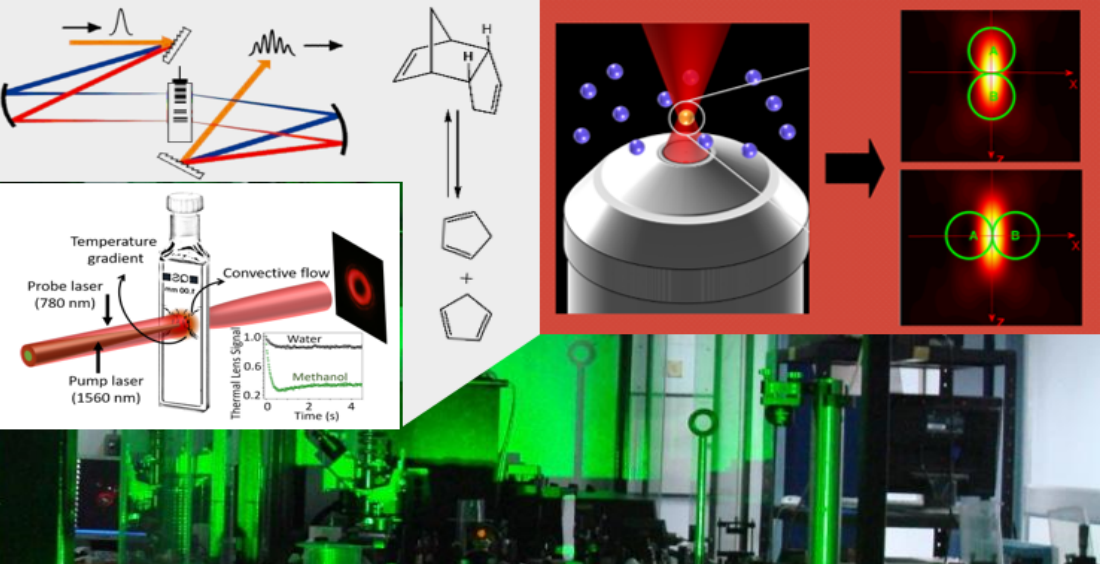
The Femtosecond Laser Lab was established in 2004 at the Indian Institute of Technology Kanpur. The group combines theory and experiment to study how femtosecond pulses interact with matter, and uses pulse shaping to steer that interaction in gaseous and liquid-phase molecular dynamics.
The current programme covers femtosecond pulse shaping and coherent control, femtosecond optical tweezers, femtosecond thermal lens spectroscopy, two-photon spectroscopy and microscopy, and optical quantum computing.
Photothermal spectroscopy, nanoscale thermometry, and two-photon techniques
Photothermal spectroscopy and two-photon techniques for molecular recognition, nanoscale temperature sensing, and dynamics across phases.
Optical qubits, coherent control of decoherence, and quantum algorithms
Optical approaches to qubits, coherent control of decoherence, and quantum algorithms using shaped femtosecond laser pulses.
Shaped femtosecond pulses to steer molecular dynamics
Shaped femtosecond pulses steer molecular dynamics, for example by restricting intramolecular vibrational relaxation.
Two-photon absorption and fluorescence of molecules in solution and cells
Two-photon absorption and fluorescence measure cross-sections, solvent effects and molecular environments, with control through pulse shaping.
Femtosecond optical tweezers, pulse shaping, and two-photon microscopy
Femtosecond optical tweezers and pulse shaping for simultaneous spatial and temporal control of molecules and colloidal particles.
Prof. Goswami delivered a lecture at JILA, University of Colorado Boulder, hosted by Prof. Henry Kapteyn, entitled “Ultrafast Science with Shaped Light: Seeing and Steering Matter and Interactions in Real Time”. The talk covered femtosecond optical tweezers, femtosecond thermal lens spectroscopy, and a time-domain theory of femtosecond trapping.
Prof. Goswami has joined the Center for Bits and Atoms at the Massachusetts Institute of Technology as a Visiting Professor, hosted by Prof. Neil Gershenfeld. The visit is supported by a Fulbright-Nehru Academic and Professional Excellence Fellowship and focuses on femtosecond laser machining toward nanofabrication.
Prof. Goswami has been selected for the JILA Visiting Fellowship program at the University of Colorado Boulder, hosted by Prof. Henry Kapteyn (IIT Kanpur Chemistry news).
The Ultrafast Nonlinear Optics and Optical Spectroscopy (UNOOS) meeting at IISER Mohali, 10 to 12 December 2024, celebrated Prof. Goswami’s academic journey on the occasion of his sixtieth birthday. It was convened by his former student Dr. Arijit K. De and had 55 lectures. Papers by participants appear in a ChemPhysChem special collection, introduced by Dr. De’s editorial (doi:10.1002/cphc.70514, 2026). Rohit Goswami presented a preliminary account of his ChemPhysChem cover feature article, “Adaptive Pruning for Increased Robustness and Reduced Computational Overhead in Gaussian Process Accelerated Saddle Point Searches” (with Hannes Jónsson, 2026), at the meeting and dedicated the article to Prof. Goswami on this occasion.
Prof. Goswami has been invited to join the Editorial Advisory Board (EAB) of The Journal of Physical Chemistry Letters for a term of January 2024 to December 2026.
We offer opportunities for Masters students, PhD candidates, postdoctoral researchers, and summer interns.